Architecture
TL;DR Think of DataCoolie as a conductor (the DataCoolieDriver) and an
orchestra of swappable musicians (plugins). The conductor reads sheet music
(metadata), tells each musician when to play, and writes the recording
(watermarks + logs). Each extension targets an abstract base class. Built-ins
are registered lazily by the runtime bootstrap when a factory or registry is
first requested, while installed extensions are discovered through Python
entry points.
Watch the architecture overview on YouTube
The mental model
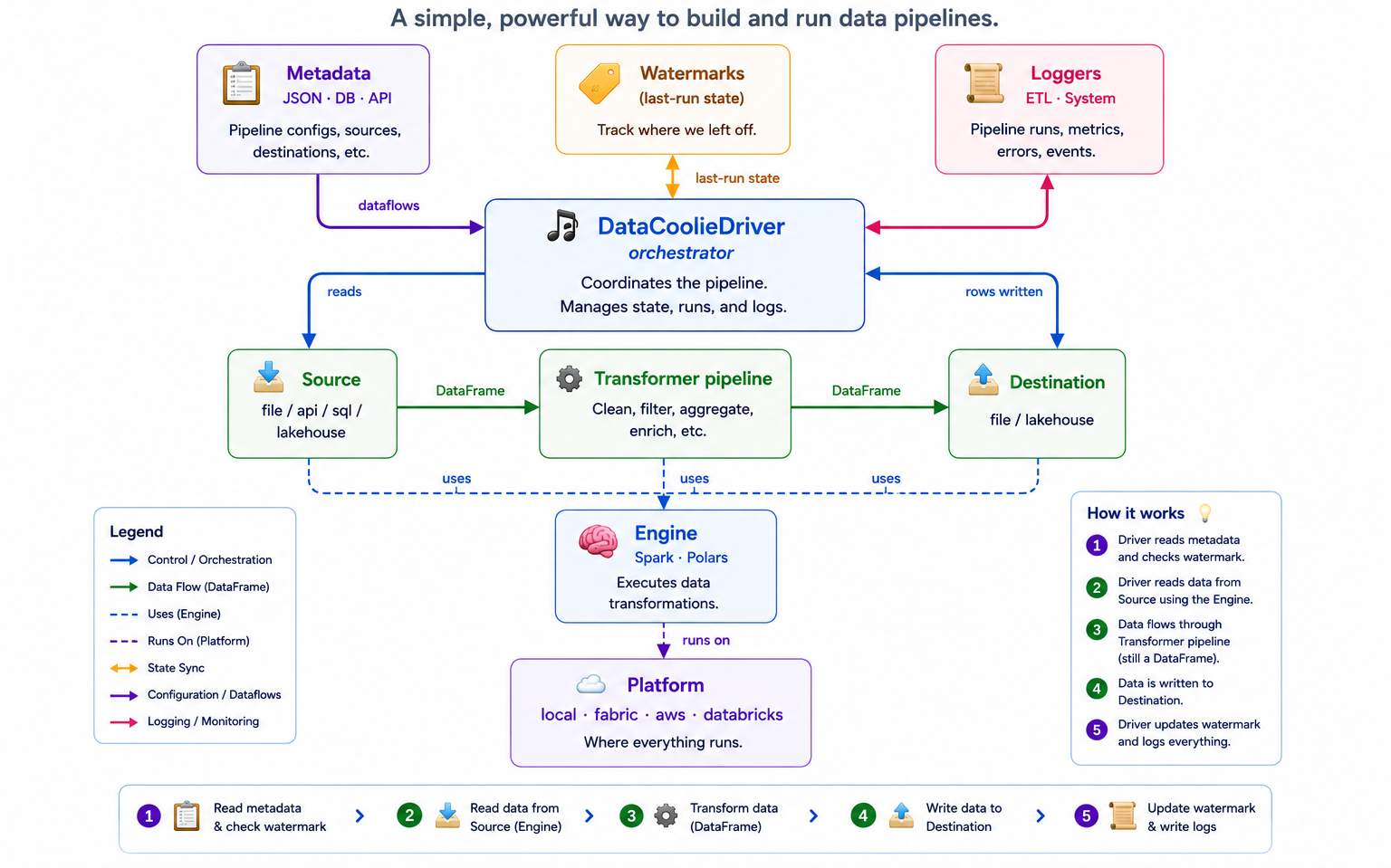
DataCoolie separates pipeline intent, execution, state, and observability into explicit boundaries. The Mermaid diagram below provides the same model in a text-friendly form.
flowchart LR
    META[("📋 Metadata<br/>JSON · DB · API")] -->|dataflows| DRV
    WM[("🔖 Watermarks")] <-->|last-run state| DRV
    DRV(["🎼 DataCoolieDriver<br/><i>orchestrator</i>"])
    DRV -->|reads| SRC["📥 Source"]
    SRC -->|DataFrame| TP["⚙️ Transformer pipeline"]
    TP -->|DataFrame| DST["📤 Destination"]
    DST -->|rows written| DRV
    ENG[["🧠 Engine<br/>Spark · Polars"]] -.runs on.-> PLT[["☁️ Platform<br/>local · fabric · aws · databricks"]]
    SRC -. uses .-> ENG
    TP  -. uses .-> ENG
    DST -. uses .-> ENG
    DRV --> LOG["📜 Loggers<br/>Execution · System"]

linkStyle 6,7,8,9 stroke-dasharray: 6 4, stroke-width: 2.25px, stroke-linecap: round;- Solid arrows = data flow.
- Dashed arrows = "uses / delegates to".
- The engine is the only box that knows what a DataFrame is; the platform is the only box that knows what a filesystem is.
The eight roles
| # | Role | Base class | What it decides | Example plugins |
|---|---|---|---|---|
| 1 | Metadata provider | BaseMetadataProvider |
Where do dataflow definitions live? | file, database, api |
| 2 | Watermark manager | BaseWatermarkManager |
How do we remember where we left off? | WatermarkManager (wraps any metadata provider) |
| 3 | Engine | BaseEngine[DF] |
What computes the DataFrame? | spark, polars |
| 4 | Platform | BasePlatform |
Where do files, tables, and secrets live? | local, fabric, aws, databricks |
| 5 | Source reader | BaseSourceReader |
How do we load this format into a DataFrame? | delta, iceberg, csv, sql, api, … |
| 6 | Transformer | BaseTransformer |
How do we shape the DataFrame before writing? | column_value_transformer, schema_converter, deduplicator, column_projector, … |
| 7 | Destination writer | BaseDestinationWriter |
How do we persist the DataFrame? | delta, iceberg, parquet, … |
| 8 | Secret provider | BaseSecretProvider |
Where do connection secrets come from? | platform-native providers via local, fabric, aws, databricks |
Secret resolvers (BaseSecretResolver) are companion syntax adapters around
that provider layer, not a ninth execution role. See Secrets and
ADR-0002.
Who depends on whom
At the extension boundary, third-party plugins depend on abstract bases only
and do not import sibling implementations. Built-in driver wiring may infer
concrete components when callers leave them unset, including FileProvider,
WatermarkManager, and engine/source/destination backend adapters. That
convenience belongs below the plugin boundary.
flowchart TB
    DRV["DataCoolieDriver"] --> BMP["BaseMetadataProvider"]
    DRV --> BWM["BaseWatermarkManager"]
    DRV --> BENG["BaseEngine[DF]"]
    DRV --> BSR["BaseSourceReader"]
    DRV --> BTR["BaseTransformer"]
    DRV --> BDW["BaseDestinationWriter"]
    DRV --> BSP["BaseSecretProvider"]
    DRV --> LOG["ExecutionLogger / SystemLogger"]
    BENG --> BPLT["BasePlatform"]
    BPLT -. also is .-> BSP
    BSR -. typed by .-> BENG
    BTR -. typed by .-> BENG
    BDW -. typed by .-> BENG
    BWM -->|raw JSON text| BMP

  linkStyle 9,10,11,12 stroke-dasharray: 6 4, stroke-width: 2.25px, stroke-linecap: round;
Key invariants:
- Driver ↔ extension contracts — third-party wiring uses the base classes; built-in defaults may select concrete providers and adapters as described above.
- Engine owns platform control-plane access —
engine.platform.list_files(...)is the framework path for metadata, log, watermark, and other control-plane filesystem operations. Business-data reads and writes use native engine connectors/adapters; platform credentials and paths do not replace them. - Secret provider is abstract too —
DataCoolieDriveraccepts an explicitsecret_provider; otherwise it falls back toengine.platformbecauseBasePlatformsubclassesBaseSecretProvider. - Sources, transformers, destinations are generic over the engine DataFrame type, which lets a type checker catch mismatches in correctly typed plugin and application code.
- Watermark manager wraps the metadata provider — provider returns raw JSON
text, manager parses
Dict[str, Any]. See ADR-0004.
Runtime flow (one dataflow)
sequenceDiagram
    autonumber
    participant Drv as DataCoolieDriver
    participant MP as MetadataProvider
    participant WM as WatermarkManager
    participant SR as SourceReader
    participant TP as TransformerPipeline
    participant DW as DestinationWriter
    participant EL as ExecutionLogger

    Drv->>MP: get_dataflows(stage)
    MP-->>Drv: List[DataFlow]
    Note over Drv: Resolve secrets → distribute → run in parallel

    loop per dataflow
      Drv->>WM: get_watermark(dataflow_id)
      WM-->>Drv: {last_value: "2026-04-19T…"}
      Drv->>SR: read(source, watermark, operator=">")
      Note over SR: watermark filter → source.filter_expression
      SR-->>Drv: DataFrame (native)
      Drv->>TP: transform(df, dataflow)
      Note over TP: value rules → schema → hashes → dedup → computed columns → row filter → SCD2 → system → partitions → masking → projection → sanitize
      TP-->>Drv: DataFrame (reshaped)
      Drv->>DW: write(df, dataflow)
      DW-->>Drv: DestinationRuntimeInfo
      Drv->>WM: save_watermark(dataflow_id, new_watermark)
      Drv->>EL: log dataflow entry
    end
    Drv->>EL: log job summary
Inside the driver, three helpers split the work:
JobDistributor— given(job_num, job_index), keeps only the slice of dataflows this worker owns. Lets you shard a run across N pods.ParallelExecutor— runs the selected slice through one coordinator pool.max_workersis the global dataflow concurrency cap for that invocation; grouped scheduling does not create nested pools. See Orchestration.RetryHandler— wraps each dataflow with configurable retries/backoff.
Why BaseEngine[DF] is generic
BaseEngine is parameterised by DF, the native DataFrame type:
| Engine | DF binds to |
Why it matters |
|---|---|---|
SparkEngine |
pyspark.sql.DataFrame |
mypy --strict sees Spark-only methods (.withColumn, …) |
PolarsEngine |
polars.LazyFrame |
mypy --strict sees Polars-only methods (.with_columns, …) |
Sources, destinations, and transformers carry the same DF parameter. This
improves static checking for plugin implementations; the non-generic driver
still relies on registry wiring and runtime contracts, so it is not a universal
compile-time guarantee for arbitrary dynamically loaded combinations.
The fmt= parameter on engine methods (read_table(fmt="delta"),
merge_to_table(..., fmt="iceberg"), table_exists_by_name(*, fmt="delta"))
unifies Delta Lake and Apache Iceberg at the engine level. See
Engines and ADR-0001.
Plugin boundary: how swap-ability actually works
The runtime exposes six plugin registries — engine, platform, source,
destination, transformer, and resolver — through the lazy package surface in
datacoolie/__init__.py.
The registries are constructed and built-ins are registered lazily by
_bootstrap when a factory or registry is first requested:
engine_registry:      PluginRegistry[BaseEngine]      = PluginRegistry("datacoolie.engines", BaseEngine)
platform_registry:    PluginRegistry[BasePlatform]    = PluginRegistry("datacoolie.platforms", BasePlatform)
source_registry:      PluginRegistry[BaseSourceReader]      = PluginRegistry("datacoolie.sources", BaseSourceReader)
destination_registry: PluginRegistry[BaseDestinationWriter] = PluginRegistry("datacoolie.destinations", BaseDestinationWriter)
transformer_registry: PluginRegistry[BaseTransformer] = PluginRegistry("datacoolie.transformers", BaseTransformer)
resolver_registry:    PluginRegistry[BaseSecretResolver]    = PluginRegistry("datacoolie.resolvers", BaseSecretResolver)
Secret providers are typically supplied by platforms, so there is no separate
provider registry. Metadata providers and watermark managers are constructor-
injected rather than registry types. Resolver plugins handle prefixed
secrets_ref sources; the provider role is satisfied by the active platform
unless you inject a different BaseSecretProvider into the driver.
PluginRegistry also performs lazy entry-point discovery: the first
.get(...), .list_plugins(), or .is_available(...) call scans the matching
installed entry-point group (datacoolie.engines, …). A third-party package
can ship a plugin by declaring:
…with no import of datacoolie at install time. See
Plugin entry points for the full
generated table.
Driver execution modes
The driver supports three execution modes through separate entry points:
| Method | Purpose | Watermark behaviour |
|---|---|---|
run() / run_dataflow() |
Normal incremental ETL | Reads > last saved, saves new max after write |
run_replay(dataflows, replay) |
Bounded historical re-processing in chunks | Operator >= (inclusive); saves per-chunk only when save_watermark=True |
run_maintenance(connection) |
OPTIMIZE / VACUUM for lakehouse tables |
N/A — no data movement |
Normal ETL loaded from metadata uses JobDistributor for active/stage
selection and job sharding, then ParallelExecutor and RetryHandler for
execution. run_replay uses a flat ParallelExecutor over the dataflows it is
given and does not apply sharding itself; callers should pass the result of
load_dataflows(...) when they need selection and sharding. Maintenance loaded
from metadata is deduplicated and distributed, while an explicitly supplied
dataflows list is deduplicated but not re-sharded. Replay adds sequential
chunk iteration within each dataflow.
See Orchestration for details on each mode.